After more than 14,000 kilometres on foot, Sven Hardt increasingly asked himself: What do other pilgrims do after their pilgrimage?
He had increasingly noticed that many pilgrims experience the so-called Camino blues after their Camino. This observation led him to develop the Via Stellaris Octo-Rosa: the pilgrimage after the pilgrimage.
The Via Stellaris Octo-Rosa is an independent pilgrimage route from Santiago de Compostela to Nazaré. It uses existing paths and infrastructure, partly against the traditional pilgrimage direction. It is neither a charity project nor an offer from PLAN-0.
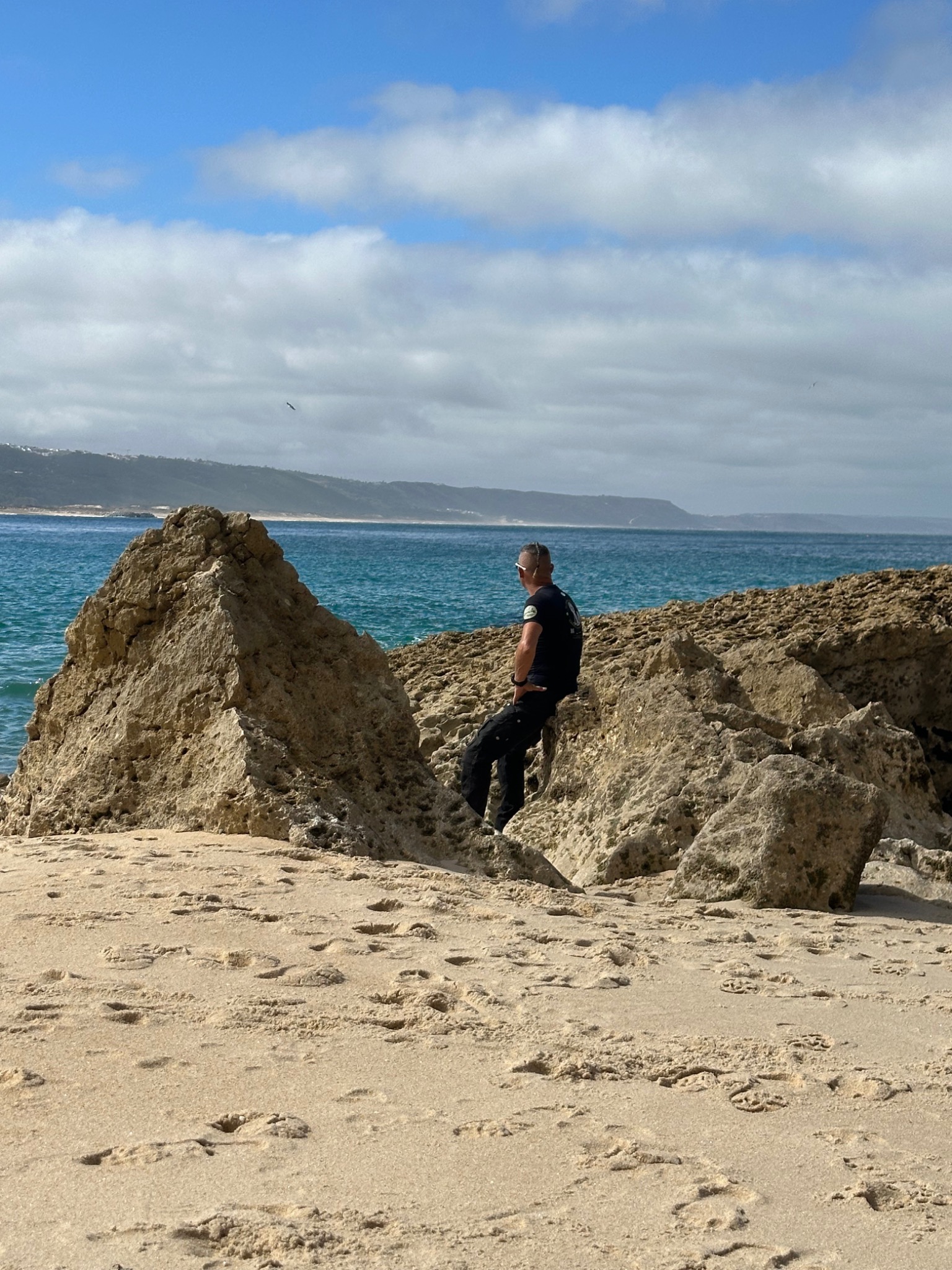
Sven Hardt – initiator, developer and first walker of the Via Stellaris Octo-Rosa.
Before this path existed
Why have people set out for thousands of years?
Long before religions had names and buildings, people were already travelling to places that were sacred to them. Later, Christians walked to Santiago, Muslims to Mecca, Hindus to the Ganges. Different destinations — the same movement.
Pilgrimage was never primarily a matter of faith. It has always been, and still is, an answer to a basic human need: to redefine one's place in the world when the old one no longer holds.
The Via Stellaris Octo-Rosa stands in this long line. Not as a new religion, and not in competition with existing paths — but as one more chapter in a practice older than any institution that later came to administer it.
The Path · 01
Why the Via Stellaris Octo-Rosa?
An independent pilgrimage route from Santiago to Nazaré. It grew out of the question of what pilgrims do with their experiences after their Camino.
Camino de Santiago
Arrival, exhaustion, grace
Via Stellaris Octo-Rosa
Reflection, healing, structure
Integration into everyday life
The path opens questions for the time after the Camino. What a person experiences and what meaning they find in it remains open.
The Path · 02
Why Portugal, specifically?
Not for geographical reasons. Three reasons that run deeper.
Historical
The land of the Templars
Portugal is the country where the Order of the Temple survived its dissolution in France — as the Order of Christ in Tomar. From here, the Atlantic was charted at a time when it still marked the edge of the known world.
Spiritual
The land of the Marian apparition
Fátima makes Portugal one of the most visited sites of Marian devotion in the world. Whoever walks the Via Stellaris moves through a landscape that has welcomed seekers for centuries.
Inner
The land that ends at the sea
Portugal ends at the Atlantic — where Europe stops and the gaze inevitably widens. It is exactly this vastness that is needed to carry through what began in Santiago.
The Philosophy
The pilgrimage after the pilgrimage
01
Mindfulness
The step that belongs only to this moment. No goal rushing past it.
02
Personal responsibility
No one carries your backpack. No one goes through your transformation for you.
03
Silence
The noise of the world only falls quiet once the body is too tired to go looking for it.
04
Reconciliation
With the path. With others. Above all: with yourself.
05
Integration
What became clear on the path must survive everyday life. That is what this stage is for.
The Philosophy
The five pillars of the worldview
They carry the Via Stellaris — and could one day become the foundation of a model in its own right.
01
Structure
Symbol
The octagon and the knightly cross
Meaning
Discipline and steadiness. An inner space of order that protects what matters.
Everyday life
Firm routines, clear boundaries — a no that needs no explanation.
Pilgrim practice
The Charola of Tomar: pure geometry as an exercise in centring.
02
Heart
Symbol
The rose (Marian mysticism)
Meaning
Empathy and devotion. True strength is soft, not hard.
Everyday life
Compassion that begins with yourself, before it turns outward.
Pilgrim practice
Fátima: the moment mercy stops being a concept and becomes a practice.
03
Spirit
Symbol
The void (mindfulness)
Meaning
Clarity and presence. Recognising the clouding of one's own thoughts.
Everyday life
Less reaction, more perception. The impulse that isn't acted on right away.
Pilgrim practice
The quiet kilometres between places, where nothing happens — except clarity.
04
Root
Symbol
The primal force of nature
Meaning
Grounding. Being part of the cycles, rather than working against them.
Everyday life
The body as an ally — not as a tool that has to function.
Pilgrim practice
The Atlantic at Nazaré: the primal force where every overestimation of the self meets its limit.
05
Fruit
Symbol
Resilience (systemic psychology)
Meaning
Effectiveness in everyday life. Insight that doesn't stay behind on the path.
Everyday life
What became clear on the Via Stellaris must survive the first Monday back home.
Pilgrim practice
The eighth day: the conscious transfer back into one's own life.
The Path · 03
560 kilometres, seven seals
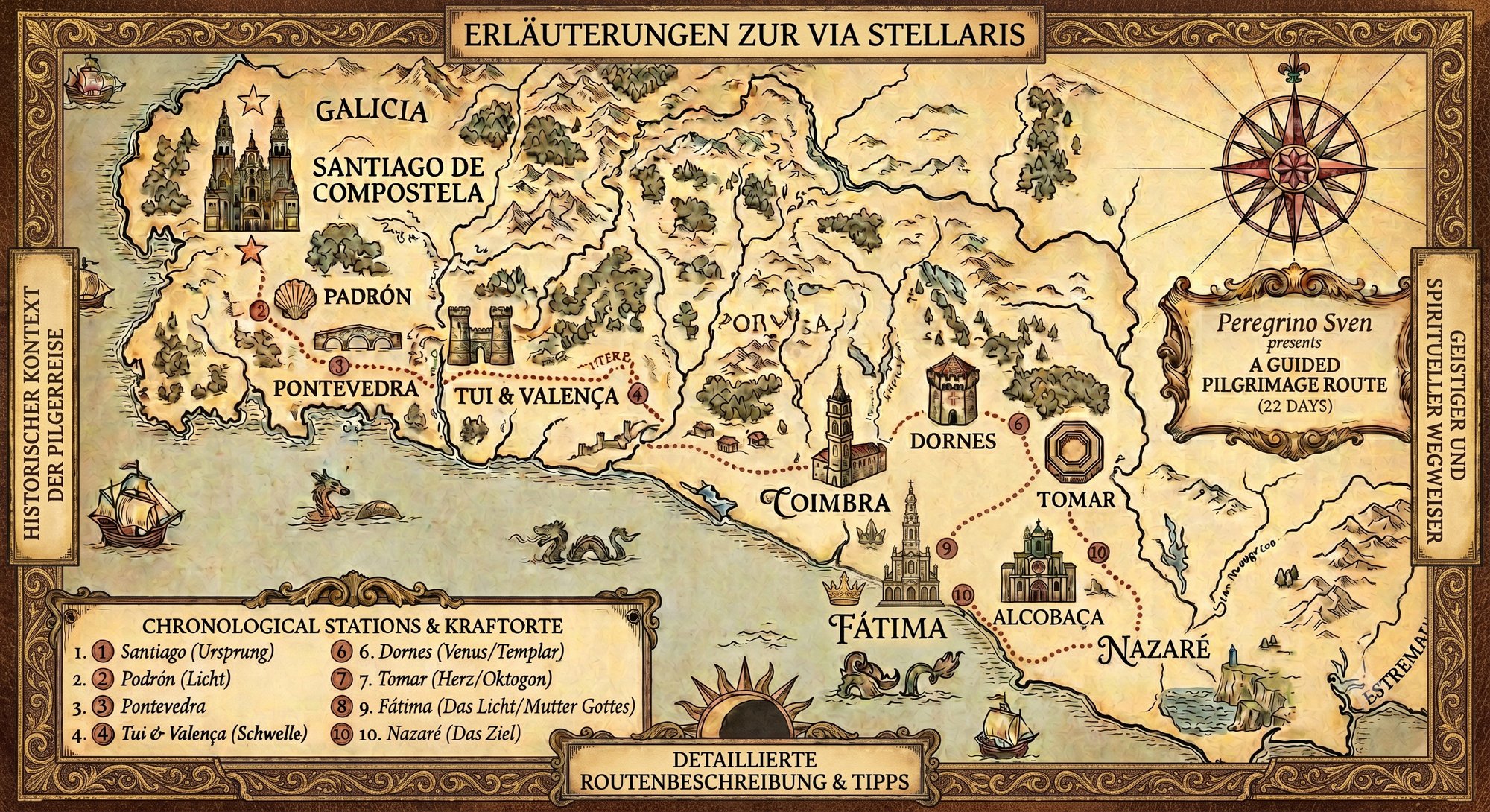
Planned route: around 560 kilometres from Santiago de Compostela to Nazaré, at least 21 stages and seven seals. The actual first walk differed from this plan.
560
Planned kilometres
≥ 21
Stages
7
Seals
5
Pillars
Ten stations. One path from Santiago de Compostela to Nazaré.
Not every step changes the path. Some steps change the person.
The Path · 04
The seven seals
The seals accompany the path with questions. What experiences another person associates with them remains open.
01
Calling
Santiago → Tui
Historical meaning
The starting point of the Santiago pilgrims since the Middle Ages — here, every departure begins anew.
Inner meaning
The "yes" to the grace you received in Santiago. The first step against the current.
What did I truly understand in Santiago?
02
Clarity
Tui → Ponte de Lima
Historical meaning
Ponte de Lima, Portugal's oldest town — a river that has separated and connected travellers for centuries.
Inner meaning
Cleansing old baggage. What you leave behind, you no longer have to carry.
What am I still carrying that no longer belongs to me?
03
Flow
Ponte de Lima → Porto
Historical meaning
The Douro and the city on the river — trade routes that have always meant movement and exchange.
Inner meaning
Becoming one with your own rhythm, instead of fighting it.
Where am I still fighting my own tempo?
04
Wisdom
Porto → Coimbra
Historical meaning
Coimbra, seat for centuries of Portugal's oldest university — a place of study and discernment.
Inner meaning
Separating the essential from the incidental, before you return.
What of this do I truly bring home?
05
Structure
Coimbra → Tomar
Historical meaning
The Charola in the Convento de Cristo, the Templars' round church — pure geometry as an expression of order.
Inner meaning
The octagon as an inner temple. Discipline that doesn't confine, but carries.
What structure protects me, instead of limiting me?
06
Healing
Tomar → Fátima
Historical meaning
Fátima, for over a hundred years a destination for pilgrims from all over the world.
Inner meaning
Mercy — first towards yourself. The rose as a counterweight to the octagon.
Who — or what part of me — do I still owe forgiveness?
07
Completion
Fátima → Nazaré
Historical meaning
Nazaré on the Atlantic — the end of mainland Europe, where the gaze inevitably widens.
Inner meaning
The salt of the sea seals what you have gained on the path.
What do I carry back into my life, as salt of the earth?
The Path · 05
The places of power
Places and themes of the path, described through Sven Hardt’s personal first walk.
01
Santiago de Compostela
The first walk began in Santiago on 12 August 2026. Santiago and Tui were associated with Vocatio: the question of a conscious yes to continuing.
02
Ponte de Lima
Ponte de Lima and the Rio Lima were associated with Purgatio. Letting go of expectations took on a practical meaning for Sven here.
03
Porto
In Porto and Gaia, Sven reflected on Unitas: connecting different areas of his life while giving each its own place.
04
Coimbra
Coimbra and Sapientia were linked to Sven’s question of which of his experiences he was already putting into practice.
05
Tomar
Tomar and the Convento de Cristo were associated with Templum, the theme of structure and centring.
06
Fátima
Alix and Sven spent three days in Fátima, extending their stay twice. Sven felt calm there despite the many people around.
07
Nazaré
Alix and Sven consciously concluded their journey in Nazaré. Sítio, the lighthouse and the beach formed part of the actual course.
Whoever walks is a pilgrim of light
Peregrino de Luz
A Peregrino de Luz is anyone who walks the Via Stellaris — regardless of origin, religion, or worldview.
Ambulans in Lumine
Peregrino de Luz is neither a membership nor an association. It is a stance: a seeker who understands crises not as misfortune, but as humus — fertile ground for what still wants to become.
Whoever walks the Via Stellaris commits to no one but themselves. They recalibrate their inner order — and afterwards carry their light back into their own community.
From humus to light: shadow and crisis are the fertile ground of growth. Without darkness, no awareness of light.
Movement creates change: every step taken outwardly sets a movement in motion within.
The unity of paths: whoever walks does not exclude, but integrates.
Responsibility in the process of maturing: the light you find on the path, you carry back into your community.
An open invitation
Who may walk this path?
The Via Stellaris carries many Christian and chivalric images. That does not mean it is open only to Christians.
ChristiansSeekersDoubtersPeople of other faithsPeople without religion
What matters is not your faith, but your willingness to walk. The symbols are a language — not a condition.
Via Stellaris Octo-Rosa
The first walk 2026
12 August 2026
Departure at 8:29 pm from the Praza do Obradoiro in Santiago de Compostela. Sven Hardt deliberately connected the time with the solar eclipse.
Via Stellaris Octo-Rosa – The Pilgrimage after the Pilgrimage
The planned route covered around 560 kilometres to Nazaré. Weather, accommodation problems and physical limits affected the actual course. Buses and other transport were also used; the route was not completed entirely on foot.
Along the Via Stellaris lie churches, pilgrim hostels and parishes that can help carry this path — through a stamp, an open gate, a bed for the night. This section will grow together with the path itself.
Coming soon
Parishes
Coming soon
Churches
Coming soon
Hostels
Coming soon
Pilgrim associations
Would you like to bring your parish, church or hostel into this? Get in touch.
For press and partners · In preparation
Media
The complete first-walk report is available. Press enquiries can be directed to Sven Hardt; additional images and downloads will be added.
Coming soon
Press
Coming soon
Downloads
Coming soon
Logos and seals
Coming soon
Image material
Coming soon
Contacts
Before you ask
Frequently asked questions
Do I need to have walked the Camino first?
No. The Via Stellaris is open to everyone. It is, however, conceived as a continuation — those who have already walked the Camino will recognise a great deal.
Am I religious enough?
There is no such thing as "enough". The Via Stellaris doesn't ask about your faith, but about your willingness to walk.
Can I walk alone?
Yes. Most pilgrims walk alone — it is exactly that which makes possible the silence the path needs.
Is the Via Stellaris a Christian path?
It uses Christian and chivalric symbols because it grew out of that tradition. Even so, it is open to everyone — see "Who may walk this path?" above.
What is Peregrino de Luz?
Neither a membership nor an association. A stance: whoever walks carries their light back into their own community.
How long does the path take?
The plan comprises at least 21 stages over around 560 kilometres. The seven seals accompany the path as themes. The duration depends on the individual course.
Do I need experience in long-distance hiking?
A basic level of fitness helps. Allow enough time for at least 21 stages; the duration depends on your pace and breaks.
Conclusion of the first walk
The conclusion in Nazaré
This was Alix and Sven’s personal conclusion. It does not establish a prescribed sequence for other pilgrims.
I
Arrival in Sítio
Their accommodation was in Sítio. Alix and Sven took the funicular up and then walked towards the church and lighthouse.
II
At the lighthouse
They talked things through at the lighthouse. Both could stand up for themselves, acknowledge the other and find a shared consensus.
III
On the beach
On the final day they spent around two hours on the beach reflecting on the journey. Sven consciously immersed his hands in the sea; for him this meant cleansing, letting go and sealing the new.
IV
A conscious conclusion
Departure was scheduled for 4 pm. They started the final day slowly and consciously concluded the journey by the sea.
About cookies. This site uses only one strictly necessary cookie, which stores your acknowledgment of this notice. Details in our cookie policy.
Legal
Legal notice
Information pursuant to Art. 10 LSSI-CE
Service provider: Sven Hardt Address: Santiago de Compostela, Spain. The full street address will be added once established. Authorised representative: Sven Hardt Register / tax number: No commercial or association register entry (private individual) Contact: sven@sven-hardt.es
Responsible for content
Sven Hardt, address as above.
Purpose of the website
This site provides information about the Via Stellaris Octo-Rosa, a private pilgrimage route, and about the Peregrino de Luz project.
Copyright
Texts, maps, seals and graphics on this site are protected by copyright. Any reproduction, editing or distribution beyond the narrow limits of copyright law requires prior written consent.
Liability notice
Despite careful content control, we accept no liability for the content of external links. The operators of the linked sites are solely responsible for their content.
Legal
Privacy policy
1. Data controller
Sven Hardt, Santiago de Compostela, Spain, sven@sven-hardt.es.
2. What data we process
Server log files: IP address (truncated), date/time, page requested, browser type — collected automatically when the site is visited, to ensure trouble-free operation. Cookies: see our cookie policy.
3. Legal bases
Art. 6(1)(a) GDPR (consent, e.g. for analytics cookies), Art. 6(1)(f) GDPR (legitimate interest in the secure operation of the site).
4. Recipients
Hosteurope (web hosting), United Domains (domain registration). No transfer to third countries currently takes place.
5. Retention period
Server-side access logs are generated automatically by the hosting provider (Hosteurope) as part of technical operations; the exact retention period follows that provider's own policies, not this site's. Cookie consent: 12 months, after which it is requested again.
6. Your rights
You have the right to access, rectification, erasure, restriction of processing, data portability and objection (Art. 15–21 GDPR), as well as the right to withdraw consent already given, with effect for the future, at any time — for example via "Cookie settings" in the footer. You also have the right to lodge a complaint with a supervisory authority — most likely the Agencia Española de Protección de Datos (AEPD), C/ Jorge Juan 6, 28001 Madrid, www.aepd.es.
This declaration does not replace individual legal advice.
Legal
Cookie policy
What are cookies?
Cookies are small text files that may be stored on your device when you visit this site. We only use the categories you have consented to — with the exception of those that are technically necessary.
Necessary cookies
Name
Purpose
Duration
Provider
via_stellaris_consent
Stores your cookie choice
12 months
This site
Analytics cookies (only with consent)
We currently do not use any analytics cookies.
Personalisation/reach cookies (only with consent)
We currently do not use any personalisation or reach cookies.
Managing consent
You can change or withdraw your choice at any time via the "Cookie settings" link in the footer. You can also delete or generally block cookies in your browser settings.